

By Dave Babbitt – Special to the Sydenham Current
This is a milestone year, that we’re sure to be reminded of many times in the coming weeks.
Everyone 60 years of age and older will likely be familiar with the story.
On November 9th, 1975, the United States National Weather Service issued a gale warning for the waters of Lake Superior, a relatively common forecast for that time of year.
By 2am of November 10th, the National Weather Service upgraded their forecast from a gale warning to a storm warning.
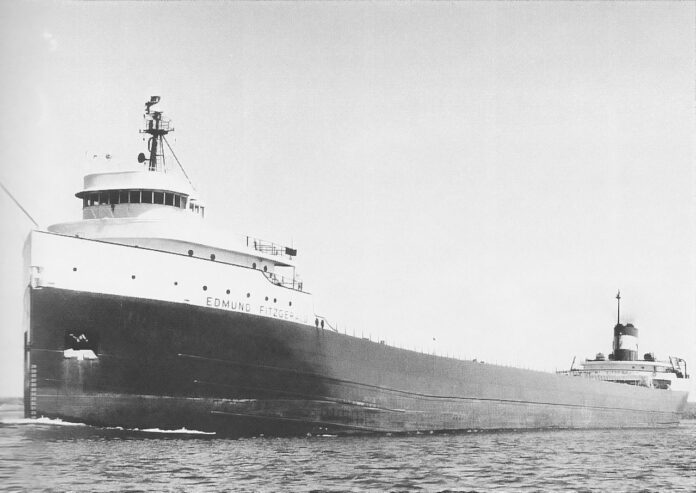
Sailing on the treacherous waters that night was the SS Edmund Fitzgerald.
The 729-foot-long Edmund Fitzgerald was the largest ship on the Great Lakes when it was launched in 1958 and by all accounts the most luxurious, possessing amenities no other ship of its day shared.
We all know what happened, and here we are 50 years later.
By 7:10 pm, on November 10th, the Edmund Fitzgerald captained by Ernest McSorley disappeared from radar in a raging storm and sank in the ice-cold waters of Lake Superior, coming to rest 530 feet below the surface.
It happened so quickly that it took all 29 crewmen to their watery grave.
I still recall the news the morning of November 11th telling us that the ship was missing and the ship Arthur M. Anderson which at one point was a mere 18 miles behind the Fitz, along other search crews were scouring the surface hoping to find survivors, but due to the severity of the storm, there was little hope.
Living where we do, we have the luxury of observing the “silent giants” of the Great Lakes up close.
My father had worked in Sarnia for Mueller Brass back in the 60’s making the daily drive along the St. Clair River and he had a keen interest in the ship traffic.
He told me that he’d seen the Edmund Fitzgerald countless times, making the story seem even closer to home.
Gar’s Bar in Marine City long had photos of the construction and launch of the Edmund Fitzgerald on its walls that I studied on every visit.
Canadian music legend and master storyteller Gordon Lightfoot had heard about the incident on CBC and subsequently read a story titled “The Cruelest Month” in Newsweek magazine, inspiring him to work on a song about the tragedy.
Shortly after the sinking in the fall of 1975, Gord was working on new songs for his next album, that was eventually released as Summertime Dream.
Lightfoot utilized a consistent band of sidemen who were always kept on a retainer in case he wished to go out on tour and the week before heading to the recording studio to record, he had his band rehearsing at his Rosedale mansion each day from noon until 6 pm.
Lightfoot drummer Barry Keane recalled that at the conclusion of the first day of rehearsals, Lightfoot began playing something they’d never heard before.
When asked by bassist Rick Haynes “what’s that?” Lightfoot said that it was a song he was working on about a shipwreck he had heard about, and he would return to it each day at the conclusion of rehearsals.
The following Monday, Lightfoot and his band headed to Eastern Sound Studios to begin recording the new album.
At the conclusion of recording each day, Lightfoot would again return to work on the “shipwreck song” and by Wednesday he and lead guitarist Terry Clements had worked out the guitar parts.
But there was no sign of any lyrics at this point.
As they had come to the studio well-rehearsed, by the time Thursday’s recording session had ended, they had already laid down all the intended tracks for the new album.
At this point, the recording engineer urged Lightfoot to lay down some tracks for the song he’d teased them with all week as they had studio time booked for the entire week anyway.
“No, it’s not ready” Lightfoot insisted but, in the end, he was convinced to at least give it a preliminary attempt.
Drummer Barry Keane, having never played the song to this point asked, Lightfoot “when do you want me to come in”?
“I’ll nod”; Lightfoot told him.
Lightfoot nodded and Keane entered with the powerful, ominous drum fill we’ve come to know so well.
A good deal of the haunting sound of the song can be attributed to the pedal steel work of Pee Wee Charles, a stage name for Waterloo-based musician Ed Ringwald.
With the tape running, they recorded their very first attempt at the song together, after which Lightfoot had the lights turned down and sang the lyrics for the first time.
They captured lightning in a bottle and to this day, the version we hear on the radio is not only the very first recording attempt, but the first time the band had ever played the song together!
The Wreck of the Edmund Fitzgerald became an unintended addition to the Summertime Dream album and eventually, a number one hit.
While they made subsequent recording attempts in the studio, none was an improvement over that first one.
That is a rare occurrence in a recording studio as most recordings involve many takes and subsequent overdubs.
The recording is a testament to Lightfoot’s impeccable preparations, and the musicianship of his sidemen.
Over many years, Gord made some alterations to the lyrics in his live performances as details of the event became clearer over time.
When it was eventually determined that the lyric “at 7 pm, the main hatchway caved-in” was erroneous, he changed the lyric to “at 7 pm it grew dark, and then” to absolve one of the crewmen of any blame.
In time, he also altered the lyric “in a musty old hall in Detroit they prayed” to “in a rustic old hall in Detroit they prayed” after he played the song in the church on the 10th anniversary of its sinking.
Having finally visited the church, he apologized and told the congregation that he wrote the lyric based on a false impression and would change it moving forward.
For those unaware, the real name for the Maritime Sailors Cathedral referred to in the song is Mariner’s Church of Detroit and it can be seen on Jefferson Avenue on one’s left when exiting the Detroit-Windsor Tunnel.
For many years, on the anniversary of the sinking of the SS Edmund Fitzgerald, as the lyric says, “the church bell chimed ‘til it rang 29 times, for each man on the Edmund Fitzgerald”.
After Gordon Lightfoot’s passing in 2023, the Mariner’s Church bell rang 30 times, 29 times for the crew of the Mighty Fitz, and once for Gordon Lightfoot himself for immortalizing the tragedy that we are still reminded of 50 years later.
The Wreck of the Edmund Fitzgerald is haunting to this day and keeps alive the memory of those who lost their lives in this legendary maritime disaster that is still plagued with many questions.
Thanks to Gordon Lightfoot, “the legend lives on….”