

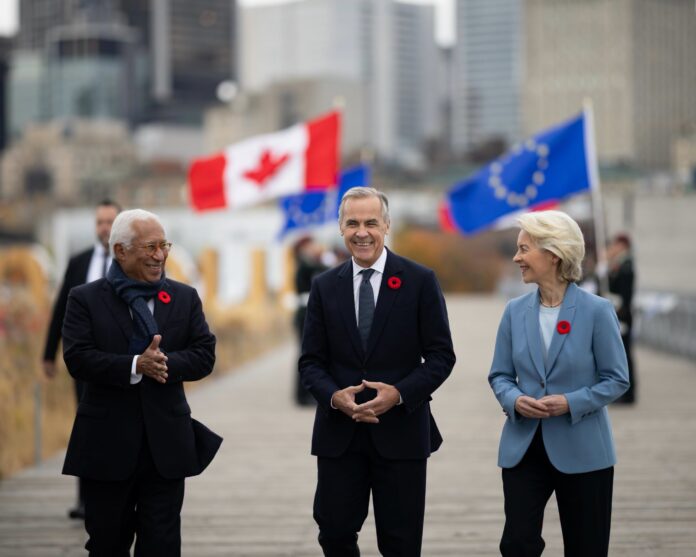
Canada and the European Union have launched what they are calling an “Alliance for the Future” at their 21st summit in Montreal, with a goal of building a common prosperity and economic security space.
In a joint statement issued Friday, the leaders said the world is changing rapidly, citing geopolitical tensions, economic fragmentation, climate change and competition for energy, resources and strategic technologies. They said Canada and the EU will build a deeper and more integrated relationship by strengthening economic ties, reducing shared vulnerabilities and building more resilient supply chains.
The statement says the alliance will rest on reciprocity in industrial sectors where both sides agree to deepen co-operation, and on a more active foreign and security policy partnership. It identifies six areas of work: trade and regulatory co-operation, digital and research technologies, critical raw materials and energy, financial services and markets, security and preparedness, and people-to-people ties.
The leaders announced that negotiations have concluded on a Digital Trade Agreement to complement the Canada-EU free trade agreement, known as CETA. They said it will improve legal certainty, make cross-border data flows easier and boost confidence in the digital economy. Negotiations have also concluded on a second-generation Competition Agreement and on an agreement between Canada and the European Investment Bank to facilitate European investment in critical Canadian resources, particularly critical raw materials.
Other announcements include Canada’s participation in the European High-Performance Computing Joint Undertaking, Canada’s intention to join the Ukraine Support Loan, and a working arrangement between Frontex and the Canada Border Services Agency. The two sides are also launching new dialogues on the Arctic, foreign information manipulation and interference, climate security and transport.
The statement says the two sides will launch negotiations toward Canadian access to the EU’s Galileo satellite navigation services and toward deeper participation in the Erasmus+ education and youth program. They will also begin exploratory talks on co-operation with the EU’s IRIS2 satellite connectivity project, and work toward Canadian participation in future European research programs, including Horizon Europe. On energy, they will conduct a joint long-term feasibility study on exporting liquefied natural gas to Europe.
On security, the leaders reaffirmed support for Ukraine’s independence, sovereignty and territorial integrity and said they will continue to pressure Russia. They also committed to deeper co-operation on defence, cyber security, wildfire management, maritime security and democratic resilience. In the Middle East, they said they will work together to support de-escalation and a lasting peace based on a two-state solution.
The statement also says the two sides will work to define, by the 2027 EU-Canada summit, the concept of an “ever-closer association” of Canada to the EU, short of full membership.
“We are stronger together,” the leaders said in closing.