
The St. Clair Region Conservation Authority has received provincial funding for wetland restoration, habitat enhancement and invasive species work in the St. Clair region.
The money comes from the Ministry of the Environment, Conservation and Parks through the Wetland Conservation Partner Program. The authority used it to create wetland, upland and riparian buffer habitat on private land and to manage invasive species on landowner properties, along road allowances and at the Keith McLean and Bates conservation areas.
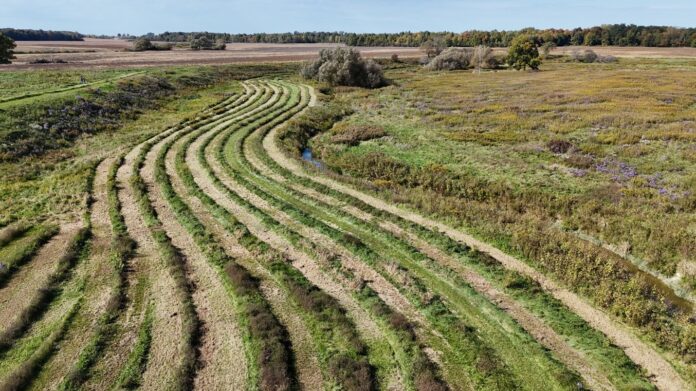
One project excavated a 1.6-acre shallow wetland complex in a farm field in Florence. It is part of a phased land retirement project by the landowners, who already have nearly 13 acres of treed and naturalized habitat. Next year, the project will add a nearly 11-acre tree planting. The landowners want to expand wildlife food and shelter habitat and reduce sediment and nutrient runoff to a municipal drain next to the field.
Another project involved a 13.6-acre riparian buffer in a retired cow pasture, where 10,700 native trees and shrubs were planted. The family involved said the planting would protect vulnerable species of birds, reptiles and insects and give the family a natural space to enjoy for generations.
“Wetlands are some of Ontario’s most vital natural infrastructure, helping to protect our communities from flooding, filter the water we drink and provide habitat for countless species,” said Environment Minister Todd McCarthy. “Through the Wetland Conservation Partner Program, our government is proud to support the St. Clair Region Conservation Authority and local landowners in their work to safeguard our natural heritage for generations to come.”
The authority says invasive Phragmites crowd out native wetland species and clog roadside ditches, which raises municipal maintenance costs and reduces sightlines. With Lambton County, local municipalities and landowners, it has developed a protocol to map treated stands each year. So far it has carried out 26 new Phragmites management plans and re-treated 27 areas for private landowners, and has made five plans for municipal and corporate partners.
At the Keith McLean and Bates conservation areas, the authority has mapped nearly all of the wetlands and invasive plants and drafted a management plan. Much of the Phragmites has been treated and will be cut this fall.
“This mapping project allows us to quantify the impact the invasive species have on the properties and further helps us to compare the effectiveness of treatment over time,” said Kelli Smith, the authority’s conservation land biologist.
Landowners interested in restoring wetland or upland habitat can contact Jessica Van Zwol at jvanzwol@scrca.on.ca or 519-245-3710 ext. 241. For tree planting information, contact Jeff Sharp at jsharp@scrca.on.ca, ext. 217.