

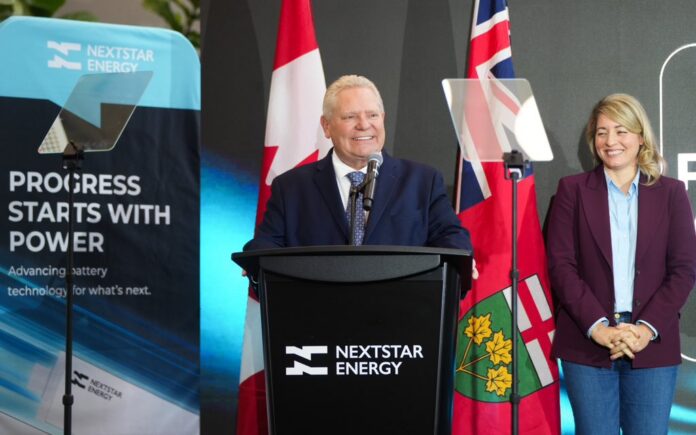
The Ontario government marked the official grand opening of NextStar Energy Inc.’s 4.23-million-square-foot advanced battery manufacturing facility in Windsor on Thursday, calling it a major milestone for the province’s manufacturing sector and a key step in strengthening Ontario’s electric vehicle supply chain.
The facility, described by the province as Canada’s first commercial-scale advanced battery manufacturing plant, is expected to create up to 2,500 jobs once it reaches full capacity while supporting the broader automotive and advanced manufacturing supply chain across the province.
“The opening of the NextStar Energy battery facility is a milestone for southwestern Ontario, creating thousands of local jobs and benefiting workers across our province’s automotive and advanced manufacturing supply chains,” Premier Doug Ford said in a statement. “NextStar’s commitment to Ontario workers reflects the hard work our government has done to cut taxes and red tape, attract historic levels of investment and build the most competitive, resilient, self-reliant economy in the G7.”
“The official opening of NextStar Energy’s Windsor facility marks a major milestone for Canada’s auto industry. This new centre of advanced battery manufacturing will accelerate our leadership in next-generation vehicles by powering the cars we build, reinforce the strength of our energy grids and develop the strategic technologies our partners and allies rely on. This reflects the industrial progress we are advancing with the Canada-Korea MOU on future mobility and strategic collaboration. Canada is not just participating in the future of mobility, but we are shaping it. Congratulations to everyone whose hard work made this milestone possible,” said Mélanie Joly, federal minister of industry and minister responsible for Canada Economic Development for Quebec Regions.
Production at the plant began in November 2025. Since then, the company says it has produced more than one million battery cells and hired more than 1,300 workers. Another 1,200 positions are expected to be added as the facility reaches full operational capacity.
Vic Fedeli, Ontario’s minister of economic development, job creation and trade, said the project strengthens the province’s role in the growing North American battery industry.
“By leveraging LG Energy Solution’s technological expertise alongside Windsor’s manufacturing might, NextStar Energy has solidified its position as a cornerstone in North America’s battery ecosystem,” Fedeli said. “We congratulate NextStar Energy on achieving these initial milestones and look forward to seeing their batteries unlock new economic opportunities for Ontario’s leading industries.”
Ontario and the federal government first announced support for the project in March 2022 as part of a broader effort to transform the province’s automotive supply chain and attract electric vehicle and battery manufacturing investments.
NextStar Energy said the facility represents a $5-billion investment in Ontario and will help support growing demand for energy storage technologies used in electric vehicles, artificial intelligence data centres and other high-energy infrastructure projects.
“Today’s grand opening reflects the economic momentum we are building here in Windsor,” said Danies Lee, chief executive officer of NextStar Energy. “With strong investment from the federal and provincial governments and the commitments from our founding joint venture partners, we are proud to be creating long-term economic value for Canada. At the same time, we are helping power the next generation of energy that will future-proof Canadian industry at scale. This is a unique, made-in-Canada success story and one we can all be proud of.”
The company was originally established as a joint venture between Stellantis and LG Energy Solution. LG Energy Solution recently announced it would purchase Stellantis’s equity stake, making it the full owner of the Windsor facility while maintaining the employment target of up to 2,500 jobs in the region.
The province says Ontario’s manufacturing sector employs more than 800,000 people and remains a central part of the province’s economy as governments and industry invest in electric vehicle and battery supply chains.