

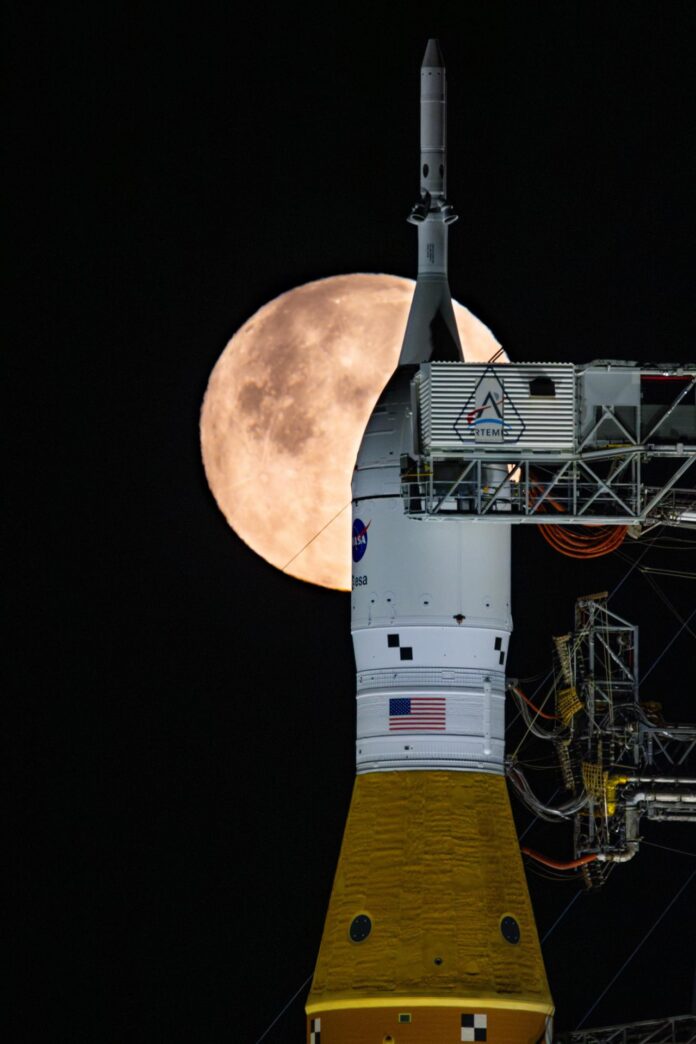
NASA has completed a key prelaunch test for its Artemis II mission, successfully fuelling the Space Launch System rocket and carrying out major countdown procedures before standing down and targeting March for the next launch opportunity.
The wet dress rehearsal, which wrapped up early Tuesday morning, involved loading cryogenic propellant into the Space Launch System (SLS) tanks, sending a team to the launch pad to complete Orion closeout operations, and safely draining the rocket. The test is designed to identify and resolve technical issues before an actual launch attempt.
NASA began the approximately 49-hour countdown at 8:13 p.m. EST on Jan. 31. Engineers monitored how cold weather at NASA’s Kennedy Space Center affected systems and implemented procedures to protect hardware. Cold temperatures delayed the start of tanking operations as teams worked to bring interfaces to acceptable temperatures.
During fuelling, engineers spent several hours troubleshooting a liquid hydrogen leak in an interface routing propellant into the rocket’s core stage. Attempts to resolve the issue included stopping the flow of liquid hydrogen, allowing seals to warm and reseat, and adjusting propellant flow. Although teams successfully filled the core stage and interim cryogenic propulsion stage tanks, the countdown was automatically halted with about five minutes remaining due to a spike in the leak rate.
Other issues included a valve associated with the Orion crew module hatch pressurization system that required retorquing, longer-than-planned closeout operations and intermittent audio communication dropouts among ground teams.
To allow for further data review and a second wet dress rehearsal, NASA now says March 6 is the earliest possible launch opportunity, with a two-hour window opening at 8:29 p.m. ET.
The change means the Artemis II crew, including Canadian Space Agency astronaut Jeremy Hansen, will be released from quarantine in Houston and will not travel to Florida as previously planned. The crew will re-enter quarantine about two weeks before the next targeted launch date.
Crew safety remains the highest priority, NASA said, as astronauts Reid Wiseman, Victor Glover, Christina Koch and Hansen prepare for the mission, which will send them around the Moon and back to Earth.
The Canadian Space Agency says Canada’s contributions to Artemis II extend well beyond Hansen’s seat on the spacecraft.
During training, Hansen and backup astronaut Jenni Gibbons helped define and validate procedures for future lunar missions. Canada also hosted geology field training for Artemis II crewmembers at Kamestastin crater in northern Labrador, led by Dr. Gordon Osinski of Western University’s Institute for Earth and Space Exploration.
Gibbons will support the mission from the ground as Canada’s first certified lunar capcom, serving as a key voice link between mission control and the crew. She is also part of the closeout team responsible for preparing Orion and conducting voice checks before launch.
Canadian technology is also playing a role. Advantech Wireless Technologies of Kirkland, Que., supplied amplifiers designed to operate on NASA frequencies, enabling communications with spacecraft up to two million kilometres from Earth. Canadian organizations, including the CSA and Defence Research and Development Canada, will help track Orion using NEOSSat and ground-based systems in Quebec and New Brunswick, while a citizen scientist in British Columbia will assist with radio tracking.
Hansen will also carry a Canadian flag, mission patches and other mementos in the mission’s Official Flying Kit. His menu includes several Canadian food items, including maple treats intended as a reminder of home during the journey around the Moon.