

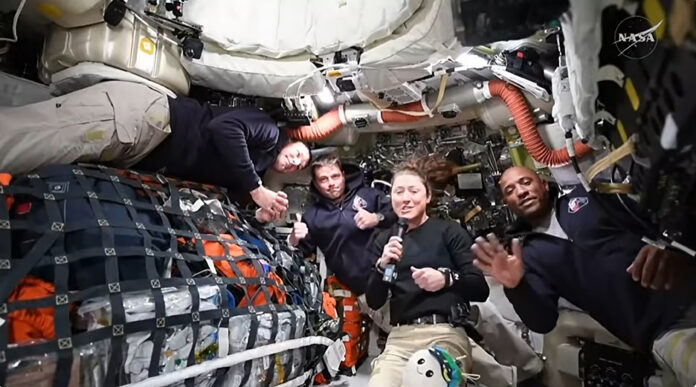
The Artemis II mission is set to complete a historic lunar flyby on April 6, 2026, with its crew expected to travel farther into space than any humans before.
The crew includes Jeremy Hansen of the Canadian Space Agency, who has already made history as the first Canadian to fly around the Moon.
The spacecraft is expected to surpass the distance record set during the Apollo 13 mission in 1970. At its closest approach, scheduled for 7:05 p.m. ET, the Moon will appear roughly the size of a basketball held at arm’s length, and the crew is expected to see areas of the lunar far side that no humans have observed directly before.
The flyby will include several hours of observation and photography of the Moon’s surface, as astronauts use real-time data and geology training conducted in locations including northern Labrador to describe surface features and help scientists better understand the Moon’s formation and support future missions.
Ahead of the flyby, Hansen spoke live with Canadians from aboard the Orion spacecraft during a space-to-Earth call organized by the CSA. He answered questions from people across the country, including youth curious about daily life inside the campervan-sized capsule and the views of Earth and the Moon from deep space.
“Sharing this journey with Canadians is incredibly meaningful to me. I want every young person watching to know that this mission belongs to all of us. I hope it sparks the imagination of the next generation, because Canada’s future in space is bright, and it will take all of us to build it,” Hansen said.
“Canadian Space Agency astronaut Colonel Jeremy Hansen is the first Canadian in history to fly around the Moon: a once-in-a-generation moment of national pride. One that will unite Canadians. As we continue to push the boundaries of space exploration deeper into space – to the Moon and on to Mars – this historic mission will inspire young Canadians to reach for the stars and become the next generation of astronauts, scientists, engineers and explorers,” said Mélanie Joly, Minister of Industry and Minister responsible for Canada Economic Development for Quebec Regions.
“Missions like Artemis II are a powerful way to connect with Canadians, especially young people. They spark curiosity, open imaginations, and show that an interest in STEM can lead to meaningful studies and careers in related fields. By inspiring the next generation today, we are helping build the skilled workforce that will shape Canada’s future in innovation and space exploration,” said Lisa Campbell, president of the CSA.
The Artemis II mission is expected to conclude with a splashdown in the Pacific Ocean off the coast of San Diego on April 10.