

By Dan White – Special to the Sydenham Current
There are moments in life that quietly change the direction of everything that follows.
For me, one of those moments happened in Grade 8 when the SCITS high school concert band came to perform at my elementary school gymnasium.
I still remember it vividly.
The sound filled the room in a way I had never experienced before. What I remember most was the tuba. I could feel it physically — a deep vibration rumbling in my gut. It wasn’t just something I heard. It was something I felt.
It helped that I already knew one of the players. Don Beryl, a friend from Air Cadets, played tuba in the band. Suddenly the musicians on stage didn’t seem distant or unreachable. They were people I knew. People I could imagine becoming.
That single performance planted a seed.
When I entered high school the following year, life outside the music room was not particularly stable.
By the end of Grade 9, I had run away from home and never returned. There were plenty of directions my life could have taken at that point, and not all of them would have ended well.
But music became my anchor.
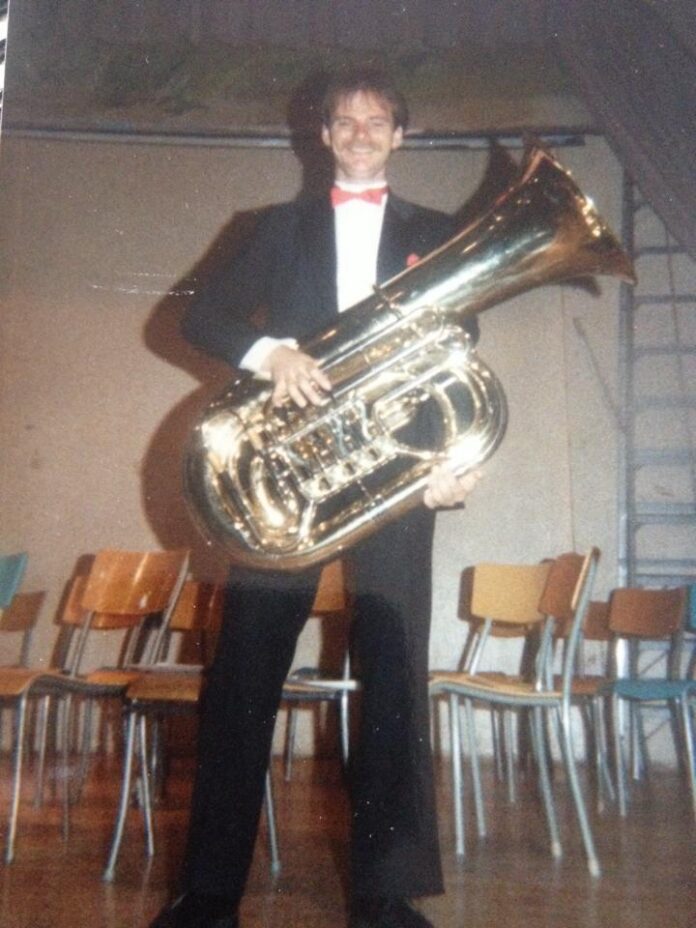
Every day after school, I wandered down to the music room to practice until the late bus arrived. Not only did it help me avoid going home, I got to know my music teacher, Mr. Jolley, as a person and I started to develop some ability on the horn.
On weekends I hauled my tuba onto the bus and took it home to practise. It was a recording bass tuba that travelled in two massive cases — one for the tubing of the instrument and another for the bell. I was a skinny Grade 9 kid carrying what felt like half my body weight onto a school bus every Friday. But I met with some success playing and success breeds success so, I practiced.
The music room became more than a classroom. It became a place where I belonged. A safe haven.
I played in concert band, jazz band, and smaller ensembles. I spent countless hours rehearsing, practising, listening, learning, and simply being around other band geeks. Long before adulthood, I learned lessons there about collaboration, discipline, accountability, and teamwork.
And perhaps most importantly, I learned that being part of something larger than yourself can help carry you through difficult times.
Years later, science is finally catching up to what musicians have understood instinctively for generations. Studies continue to show that playing music strengthens memory, coordination, concentration, emotional regulation, and cognitive flexibility. Ensemble playing requires constant problem-solving and communication. Musicians are simultaneously listening, adjusting, anticipating, supporting, and creating.
But beyond all of that research is something harder to measure.
Music builds community.
That is especially true in community concert bands.
Over the past year, Joni and I have had the privilege of performing with the Wallaceburg Concert Band, the Lambton Concert Band, and the Chatham Concert Band. These organizations represent 10, 25, and nearly 100 years of history respectively. The upcoming BandTogether performance at Tecumseh Park will help launch the Chatham Concert Band’s 100th anniversary celebration — a remarkable milestone for any community organization.
What becomes immediately clear when you spend time with these ensembles is that they survive entirely because people care enough to make them survive.
The musicians are volunteers.
The executives and organizers are volunteers.
The conductors dedicate countless hours preparing music, planning rehearsals, and building programs.
Many performances are offered free to the public. Others charge a modest admission fee that covers only a fraction of the actual cost of operating an ensemble the size of a concert band. Instruments, music, rehearsal spaces, insurance, transportation, equipment, and maintenance all require funding.
These organizations do not exist because they are profitable.
They exist because communities decide they matter.
And communities benefit enormously when they do.
Concert bands perform at Remembrance Day ceremonies, festivals, parades, park concerts, community celebrations, and charity events. They provide opportunities for lifelong learning and artistic expression. They connect generations. They create spaces where teenagers rehearse beside retirees and where experienced musicians mentor those just beginning.
Perhaps most importantly, they remind us that art is not a luxury.
It is part of the emotional and cultural infrastructure of a healthy community.
Recently, I read a story about a high school band in Wisconsin whose performance was cancelled by local officials because of objections to the woman the chart was written to honour, Maesha Johnson — a Black transgender woman. What happened next was extraordinary. A local brewery offered its venue so the students could still perform. When access to school instruments became an issue, local music stores and community musicians stepped forward to lend instruments so the concert could proceed.
That story resonated with me because it demonstrated something important: communities will often fight to preserve music because people instinctively understand its value, even when they struggle to articulate it.
Music gives communities identity.
It gives people belonging.
Sometimes, it gives young people direction when they need it most.
A concert band may simply look like a group of people on stage holding instruments.
But inside that ensemble are friendships, mentors, volunteers, teachers, students, retirees, working parents, lifelong learners, and people carrying stories you may never know.
Somewhere in the audience may be a Grade 8 student hearing a tuba for the very first time.
And perhaps, without realizing it, beginning a journey that will change their life forever.