

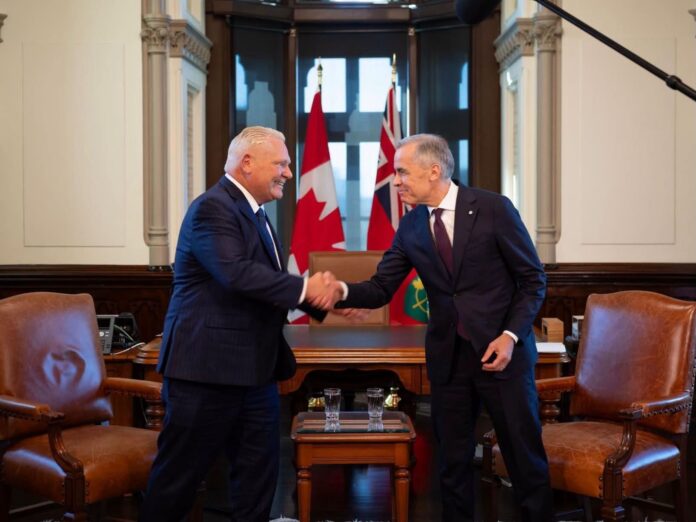
Premier Doug Ford and Prime Minister Mark Carney have announced $8.7 billion in investments and new measures aimed at strengthening Ontario’s steel, automotive and critical minerals sectors and supporting workers and businesses affected by U.S. tariffs.
“Working in partnership to protect Canadian workers, Ontario and Canada are fortifying our industrial base and securing the good-paying jobs of the future,” Ford said. “The agreement we are announcing today is the next step in our ongoing partnership to provide tariff-impacted workers the certainty and stability they deserve, while unlocking Ontario’s vast supply of critical minerals and building a more competitive and resilient economy that can stand up to anything that comes our way.”
Carney said the plan shows the two governments working together.
“From mine to mill to assembly line, Canada and Ontario are protecting jobs today and making bold investments that will build a stronger, more resilient, more independent Canadian economy for tomorrow,” Carney said. “Today’s action plan is cooperative federalism in action. Canada is strong. Canada is united. Canada is working.”
For the steel sector, the governments will create a Joint Steel Action Fund with five-year commitments of $3.55 billion from Ottawa and $1.67 billion from Ontario. The fund is meant to diversify production, prepare steel firms to supply growing Canadian industries such as defence, advanced manufacturing and energy, and open overseas markets. The governments also plan to prioritize Canadian steel in public procurement through the Buy Canadian and Buy Ontario policies, and to step up enforcement against foreign steel dumping and unfair subsidies through the Canada Border Services Agency. A Canada-Ontario Steel Task Force will advise on the measures, with its first priority being ways to reduce steel shipping costs.
For the automotive sector, the governments will invest an additional $2.5 billion over two years in capital projects so manufacturers can modernize machinery and production lines for connected and electric vehicles. Ottawa is contributing $1.5 billion and Ontario $1 billion. Canada will also keep its greenhouse gas emissions standards for new light-duty vehicles at 2026 levels through the 2029 model year, with annual increases resuming in the 2030 model year. A Canada-Ontario Automotive Task Force will support the industry’s transition.
On critical minerals, the federal government will match the province’s initial investment of up to $1 billion over three years for road infrastructure to support development in the Ring of Fire region of Northern Ontario. The governments will also set up a coordinated federal and provincial permitting process, identify priority projects that could qualify for federal funding programs, and create a working group to engage First Nations. That group will also study options for conservation or Indigenous protected areas as development proceeds.
The federal government says it has provided more than $25 billion in support to workers and businesses affected by U.S. tariffs and announced a further $7.5 billion in new and enhanced measures in August. It says Canada’s automotive sector supports more than 120,000 direct jobs and contributes more than $16 billion a year to GDP, while the steel industry supports more than 23,000 direct jobs.