

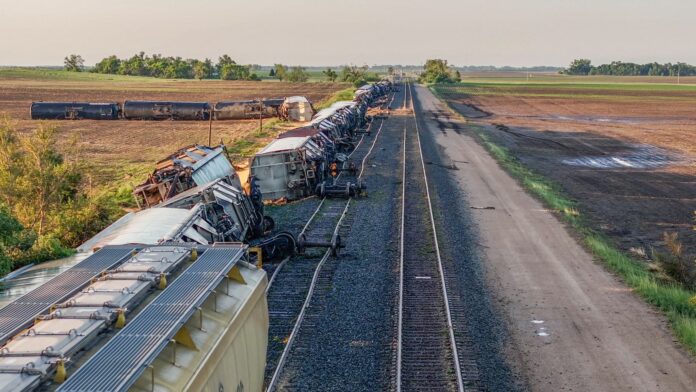
After weeks of engineering analysis, supported by a new technique developed by Western University’s Canadian Severe Storms Laboratory (CSSL), a tornado that struck Enderlin, North Dakota this summer has been officially rated EF5 by the U.S. National Weather Service (NWS) — the highest category on the Enhanced Fujita (EF) scale.
The historic rating was made possible through the application of research from the Northern Tornadoes Project (NTP), which provided the scientific foundation for confirming wind speeds exceeding 210 mph (338 km/h). The NWS reports that this EF5 tornado is the first of its kind in the United States since the Moore, Oklahoma tornado in 2013, tying the EF wind speed record with the 2011 El Reno, Oklahoma tornado.
“This case exemplifies the importance of integrating engineering analysis and scientific research into operational meteorology,” said Connell Miller, director of the Northern Mesonet Project and former NTP wind impacts researcher. “Our work demonstrates that extreme wind events can be reliably assessed using forensic evidence to improve wind speed estimates in tornadoes.”
A violent tornado tore through southeast North Dakota on June 20, 2025, leaving a 12.1-mile (19.5 km) path of devastation up to 1.05 miles (1.7 km) wide. Initial NWS assessments suggested high-end EF3 damage but lacked sufficient EF Scale damage indicators to justify a higher rating.
The Enderlin tornado derailed 33 train cars, including several fully loaded grain hoppers weighing about 286,000 pounds (129,700 kg) each. One empty tanker car, weighing roughly 72,000 pounds (32,600 kg), was lofted more than 145 metres from the tracks.
To estimate the wind speeds required to cause this level of displacement, experts applied findings from a 2024 peer-reviewed study led by Miller, published in Monthly Weather Review, titled Estimating Wind Speeds in Tornadoes Using Debris Trajectories of Large Compact Objects (https://doi.org/10.1175/MWR-D-23-0251.1).
That research established that lofting large compact objects more than 50 metres generally indicates EF5-level winds. In Enderlin, a fully loaded tanker car—nearly four times heavier than the heaviest object modelled in the study—was thrown almost three times farther than the EF5 threshold distance.
Calculations on the Enderlin train car confirmed wind speeds well above the EF5 threshold, providing the critical evidence needed to confirm the tornado’s classification despite the absence of traditional EF-scale damage indicators.
“The National Weather Service’s use of this research underscores its significance for future tornado assessments, offering a powerful new tool for rating storms that produce extreme yet unconventional damage,” said Miller. “CSSL and NTP remain committed to advancing tornado science and supporting operational meteorology through innovative engineering methodologies.”
For more information on the Enderlin, N.D. tornado, the U.S. NWS has provided a backgrounder at https://www.weather.gov/media/fgf/Enderlin.pdf.