

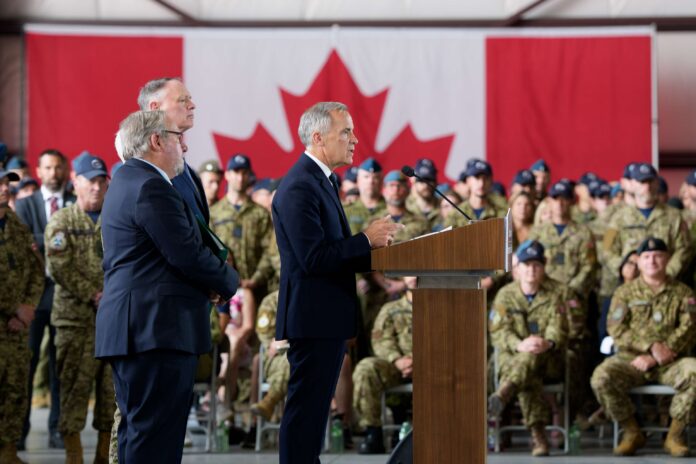
Prime Minister Mark Carney says Canada has reached NATO’s two per cent defence spending target, years ahead of schedule, alongside billions in new military and infrastructure investments.
The announcement, made Thursday in Halifax, comes as the federal government moves to expand defence spending in response to what it describes as a more dangerous and divided global environment.
“In moments of crisis, when people see the Maple Leaf on a sleeve, they see hope. They get help,” Carney said. “Canada’s new government made a promise to rebuild, rearm, and reinvest in the Canadian Armed Forces – and we’re getting it done.”
Canada’s defence spending had fallen to about one per cent of GDP by 2014, according to the government, well below NATO expectations. Carney said recent efforts have rapidly increased that figure through more than $63 billion in spending across multiple departments.
“Reaching the 2% benchmark is a foundational step in renewing Canada’s defence and a clear statement of resolve in a more dangerous world,” Defence Minister David McGuinty said, adding the investments are aimed at strengthening readiness and sovereignty.
The government says the target has now been met five years ahead of the previous timeline and will serve as a base for further increases, including a longer-term goal tied to NATO’s new defence investment pledge.
As part of the announcement, Ottawa is committing more than $3 billion to defence-related projects in Atlantic Canada, including upgrades to naval and air force infrastructure in Nova Scotia and expanded training capabilities in New Brunswick.
“Atlantic Canada has always punched above its weight when it comes to defending Canada, at home and abroad,” said Justice Minister Sean Fraser. “Here in Nova Scotia, that means good jobs, growing industries, and a defence sector that continues to lead.”
The federal government says the investments include modernizing facilities at CFB Halifax, building new aviation support infrastructure at 14 Wing Greenwood and enhancing training capacity for future naval operations, along with major upgrades at CFB Gagetown.
Officials say the broader strategy includes long-term investments in equipment, personnel and procurement systems, with plans to spend hundreds of billions of dollars over the next decade.
“Canada achieving the 2% commitment half a decade ahead of schedule lays the groundwork for a stronger and more prepared Canadian Armed Forces,” said Stephen Fuhr, secretary of state for defence procurement.
The government says Canada will continue working toward NATO’s updated target, which calls for increased defence and security-related spending by 2035, while expanding partnerships with allies and strengthening the domestic defence industry.