

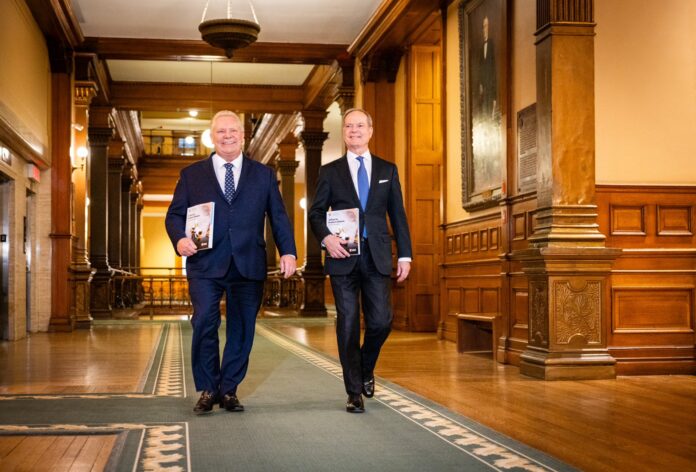
Ontario’s finance minister tabled the province’s 2026 budget Thursday, promising tax relief, increased infrastructure spending and targeted investments as the government responds to global economic uncertainty.
The spending plan, titled A Plan to Protect Ontario, focuses on strengthening the province’s economy while maintaining a path to balance, according to Finance Minister Peter Bethlenfalvy.
“Ontario is navigating economic challenges with a pragmatic and prudent fiscal plan,” Bethlenfalvy said. “To help the province navigate these times and come out stronger, we are investing in strategic priorities such as energy, critical minerals, key infrastructure and critical technologies that will make our economy stronger.”
The budget includes a range of measures aimed at lowering costs for residents and businesses, including a proposed cut to the small business corporate income tax rate and additional relief for homebuyers.
Under the plan, the province would remove the provincial portion of the harmonized sales tax on new homes valued up to $1 million, with relief maintained on homes up to $1.5 million. The government says the move, in partnership with the federal government, could provide up to $130,000 in savings for eligible buyers.
The province is also proposing to reduce the small business corporate income tax rate from 3.2 per cent to 2.2 per cent starting July 1, 2026, a move it says would benefit more than 375,000 businesses.
Despite economic pressures, the government says it will continue to increase spending in key areas, including health care, education and infrastructure, while avoiding tax increases and service cuts.
“Ontario’s 2026 Budget reflects the benefits of the province’s resilience and prudent fiscal management to date,” Bethlenfalvy said.
The plan outlines more than $210 billion in infrastructure spending over the next decade, including $37 billion in 2026-27, aimed at building highways, hospitals, transit and community projects.
New funding commitments also include expanded support for the Ontario Autism Program, increased investment in primary care to connect more residents with family doctors and additional funding for community sport and recreation infrastructure.
The budget projects a deficit of $12.3 billion for 2025-26, an improvement from earlier forecasts. Deficits are expected to continue in the near term before a projected return to surplus in 2028-29.
The government says the plan is designed to keep Ontario competitive while providing flexibility to respond to changing economic conditions.