
By Dave Babbitt – Special to the Sydenham Current
My goals this week are to both educate and (hopefully) vindicate.
I’ve heard it said that a music conductor is “the last bastion of true dictatorship”.
I’ve had music students who have gone on to study at the university level who have told me horror stories of fellow students being chewed apart by music professors in the presence of everyone else.
The orchestral world has had many prominent conductors who are renowned for their fiery tempers, intensity, perfectionism, and attention to detail.
The great Arturo Toscanini had been known to fire musicians on the spot in a rehearsal, and Leonard Bernstein is another renowned “difficult” conductor to work under.
To a large extent, I understand that their expectations should be of the highest level as every musician in a world-class orchestra has undergone intense vetting via interviews and auditions, competing with the finest musicians from around the world for their position.
On the other hand, I lead a collection of amateur, volunteer musicians and I never choose to belittle them.
So “what do conductors want”?
Being a conductor myself, albeit not a very skilled one, I have some insight as to what a conductor’s roles and expectations entail.
In Europe, the main conductor of an orchestra is oft referred to as the “Chief Conductor” while in North America is more commonly referred to as the “Principal Conductor”.
The Principal Conductor is “the primary artistic leader and musical director of an orchestra or choir” but that same description applies to what I do as a concert band conductor.
It needs to be pointed out however that the Principal Conductor does not conduct every concert during a season as guest conductors are often employed to conduct specific concerts or a series of concerts such as a “Pops” series for example.
Both in my own case as well as that of professional conductors, it is our responsibility to program a band or orchestras season or in layman’s terms, choose the music the band/orchestra will perform.
The programming portion of a conductor’s responsibilities is a personal journey far removed from the musicians and involves many factors including personal bias, history of past performances, special requests, a perceived duty to educate, location of performance, time of year etc.
I for one have begun the process of choosing music for our Wallaceburg Concert Band for April of 2027 already.
While a conductor is most visible in a concert situation, what I consider to be the main role of a conductor, takes place in rehearsals.
It is the conductor’s duty (and pleasure I might add) to interpret a score and have the musicians under their control bring the notes on the page to life.
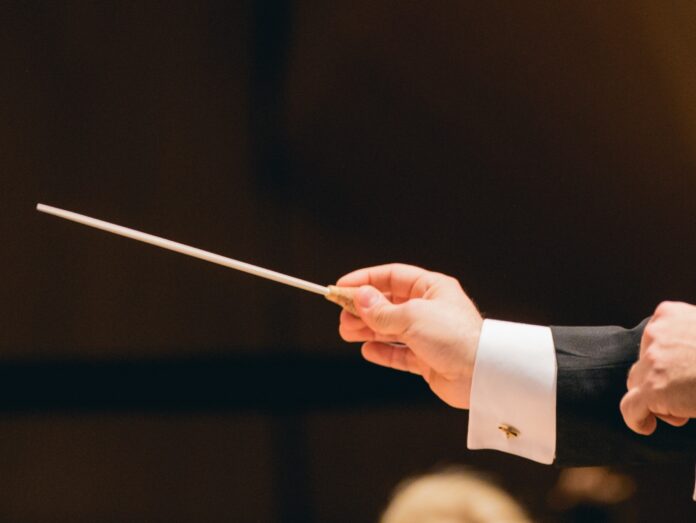
In a concert scenario, the conductor will use hand gestures, body movements, and often a baton that the musicians can follow, but in rehearsal situations, vocal instructions are also very important.
I often suggest to the musicians I lead that I miss making the music, as I too began my journey as a performing musician, but my role now is to “craft” their music into something enjoyable both for themselves and an audience.
My personal philosophy is that the journey is far more important than the destination.
While I am in control of rehearsals and concerts, I like to approach our work as a co-operative effort and I attempt to make each of our rehearsals fun, interesting, and fruitful without being a “dictator”.
So what do conductors actually do?
We start the ensemble, stop the ensemble, set tempos, changes in tempos, help shape phrasing, articulation, in some cases voicing, bring in sections and soloists, and in my particular case interpret dynamics and dynamic changes. (ie volume)
If one has never read music notation, there are many different elements on the page, and I always suggest that every drop of ink has meaning that needs attention.
Scores most often have notes from the composer that will suggest how they envisioned the music should be played, but as Conductor, I have a secret weapon.
I have what is referred to a “musicians’ licence” which allows me to make changes as I see fit.
A selection of music can be played many ways of course and sometimes I want to deviate from what has been suggested by the composer or arranger.
Think of Neil Sedaka’s “Breaking Up Is Hard to Do” which was originally presented as an up-tempo piece of pop music, but in time he re-recorded it as a slow ballad.
A typical WCB rehearsal will entail many stoppages in the music as I attempt to correct rhythmic errors, or have the musicians play a certain passage with different phrasing, articulation, and most often volume (or dynamic) level.
The suggestion that a particular section be played at a “forte” (or loud) level, is often inappropriate for our band.
Having 10 trumpets in our band all playing forte makes the music far too loud and overpowering. I may need all ten trumpets to play at more of a “piano” (or soft) level to keep the cumulative volume at a more appropriate level.
My main point is that my work as a conductor is completed long before our band takes to the stage.
By the time our band reaches concert time, having rehearsed the music dozens of times, the musicians will know their music and what I expect, intimately.
For example, at our last concert, we were presenting “Just A Closer Walk with Thee”. It starts out as a very slow funeral march tempo but in the middle, slows down, then comes to a stop. At that point, the piece turns into a rousing, high speed New Orleans “celebration of life”.
We had rehearsed that selection enough that once I started the band up, they were on auto pilot, which on that day, was a good thing.
I became rather unwell and after I started the band, I left the auditorium.
Due to solid preparation, the band was able to navigate the tempo changes without me and took the song to its rousing conclusion.
I only made it back in time to have the band stand and make their bows.
Hopefully readers now have a clearer picture of what a Conductor does.
Now for the vindication part.
One may need to ask a band member but don’t believe that I am a Toscanini or Bernstein.
I have great respect for the musicians that I have the privilege to conduct and attempt to make their journey enjoyable.
I hope that is why we continue to grow both musically and in size.