

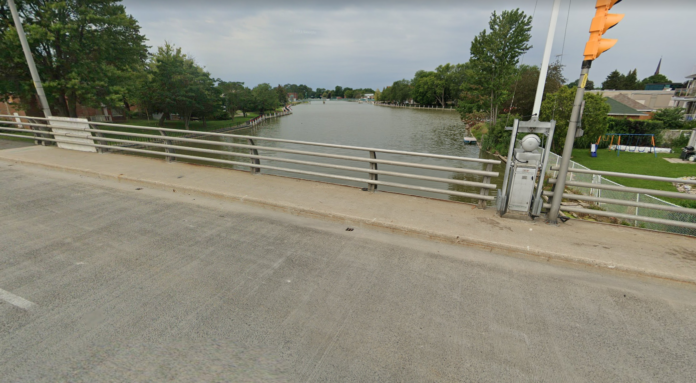
Chatham-Kent Council has approved a $1.9-million rehabilitation project for the Murray Street Bridge in Wallaceburg.
Council unanimously approved the tender be awarded to Landform Civil Infrastructures Inc. of Hamilton during the consent agenda portion of their meeting on Monday, September 12, 2022.
An approved staff recommendation states the value is not to exceed 10% above the engineer’s estimate, subject to the negotiation of an agreement satisfactory to the director of legal services and the general manager of infrastructure and engineering services.
If successful with the first recommendation, an agreement will be entered into with Landform for the work.
If unsuccessful, administration will proceed with cancelling the contract and proceed with separate tenders for the required electrical work, including programmable logic controller hardware and software, mechanical work, and roadway wearing surface rehabilitation.
“The Murray Street Bridge over the Sydenham River was built in 1974,” a staff report indicates.
“With an average annual daily traffic volume of 10,600 the crossing is heavily used with truck volumes accounting for 10 to 25 percent of the total traffic.”
The bridge was last rehabilitated in 2006.
Per the terms of the tendered contract, a staff report indicates work may commence any time after Council approval, with a completion date of March 31, 2023.
“The contractor is required to allow the bridge to be operated to allow larger boats to pass until October 15, 2022, which is the end of the navigation season where bridge operation is required,” Jason Cikatricis, engineering technologist, said in a staff report.
“After October 15, 2022, the contractor will not be operating the bridge for larger boats but will continually provide a navigational opening of 1.5 m vertical by 3.0 m wide (or larger if possible) for smaller boats.”
Cikatricis said due to the fact that the LO Stonehouse Pedestrian Bridge is currently closed, the contract specifies that one of the two sidewalks will be accessible 24 hours a day, seven days a week.
“The bridge will be closed to vehicular traffic for approximately four to six weeks,” Cikatricis added.
“After that time period, the contractor is allowed to keep one lane of traffic closed for the duration of the project. Two detours will be in place, consisting of a detour to take the bulk of the traffic around the site and the other detour will be mainly for local traffic.”
Cikatricis said due to the time of the year, the weather, and the nature of the work, the estimated duration of construction is approximately 100 working days or 20 weeks.
Staff says based on Ontario Structure Inspection Manual (OSIM) Inspection in 2021, a detailed
condition assessment in 2017 and site inspections completed by AECOM Canada Ltd., the Murray Street Bridge was identified to have a number of conditional issues and operational issues that needed to be addressed in order to maintain public safety and extend the life of this structure.
The current contract consists of the following work:
This contract consists of the following work:
– Removal and replacement of the specialized coating on the orthotropic steel bridge deck which is the movable portion of the bridge.
– Removal and replacement of the specialized coating on the sidewalk which is the movable portion of the bridge.
– Complete various concrete repairs to the pier, abutments and control tower.
– Coating of various concrete components.
– Spot repairs to the orthotropic steel deck may be required.
– Spot cleaning and painting of some of the structural steel and trunnion bearings will be required.
– Mechanical components such as the pit room, bearing locations and the trunnion bearings will be cleaned and the grease will be replaced.
– Spot cleaning and painting will be completed to mechanical components such as span lock actuators, nose lock linkage system and trunnion assembly.
– Hydraulic Power Unit (HPU) flow rate gauge, hoses and disconnects will be replaced and flushed.
– The span lock brake support will be re-designed and the brake wheel will be re-aligned.
– The primary reducer output shaft will have the seals replaced and heaters added to the gate assembly housing.
– The Variable Frequency Drive (VFD) will be serviced by replacing corroded conduit connections, hardware, and ground blocks.
– Surface corrosion in termination cabinets will be removed.
– Limit switch arms will be recoated, and general cleaning and replacement of corroded bolts will be completed.
– Labels on all wiring will be replaced and disconnect switches for main and auxiliary motors will be installed.
– Window tint will be added to the existing control tower windows to reduce glare while operating the bridge and reducing the amount of heat generated in the control tower.
– The PLC hardware and software will be completely replaced which includes a larger more functional and user-friendly monitor.
A letter of recommendation from the engineer can be read, here.
The full staff report can be read, here.